
Short answer
Section 1926.451(g) assigns different fall-protection approaches to different scaffold types and activities. It addresses personal fall arrest, guardrails, walkways, overhand bricklaying, erection and dismantling, lifelines, support lines, and detailed guardrail criteria. Do not reduce it to one universal height statement.
Scope and source boundary
This guide uses the supplied 59-page OSHA scaffold publication as its primary source document and checks regulatory statements against current official OSHA pages. The uploaded publication is a historical educational reference; OSHA controls its standards, interpretations, enforcement materials, and updates.
Source-derived requirements, general planning guidance, Upright product pathways, and site decisions are not interchangeable. Exact equipment instructions govern product configuration. The employer and the required competent person, qualified person, trainer, engineer, or other responsible party must apply current requirements to the actual scaffold, activity, jurisdiction, and worksite.
- PDF pages 21–26
- §1926.451(g)
- Appendix B
Scaffold type changes the protection analysis
The rule separately addresses boatswains’ chairs and several other suspension formats, single- and two-point adjustable suspension scaffolds, crawling boards, self-contained adjustable scaffolds, walkways, overhand bricklaying, and scaffolds not otherwise specified.
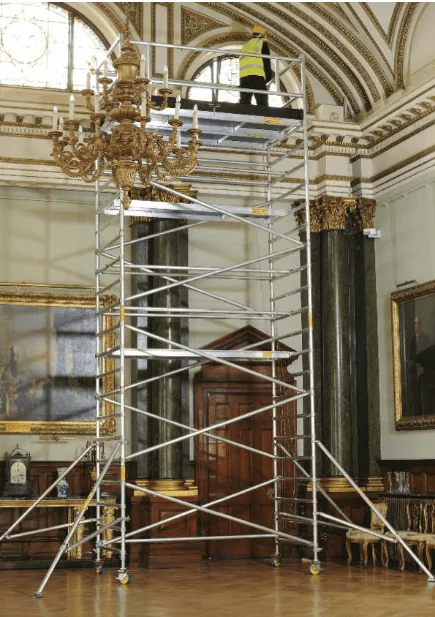
A supported mobile tower image cannot explain the requirements for a suspension scaffold, and a guardrail component page cannot approve a complete protection system. Identify the scaffold and work first.
Guardrails, open sides, ends, and access openings
Guardrail provisions address installation along open sides and ends, timing before release for use, top-edge height, midrails or equivalent members, strength, surfacing, projection, banding, and other construction details. Exceptions and effective-date context in the current rule matter.
Gates, ladders, stairways, trapdoors, material transfer, and work-face openings create transitions that need explicit review. A rail visible in a rendering is not proof that every opening is protected.
Personal fall arrest, lifelines, and anchor planning
Scaffold personal fall-arrest provisions connect to §1926.502 and add requirements for attachment, vertical and horizontal lifelines, independent support lines, and separation of suspension and lifeline anchorages.
Anchorage selection and rescue planning are not product-card decisions. A named building element, pipe, counterweight, outrigger beam, or scaffold member must not be assumed acceptable without applying the current criteria.
Erection and dismantling feasibility decisions
The rule assigns a competent person the decision about feasibility and safety of fall protection for employees erecting or dismantling supported scaffolds and requires protection where feasible without creating a greater hazard.
This is a work-specific determination, not a blanket exception. Document the sequence, available protection, changing exposures, access, supervision, and current requirements.
Apply this topic through a controlled project record
Begin the scaffold fall protection review with evidence rather than assumptions. Record the exact scaffold family, model and component markings; retain the current manufacturer instructions; identify the applicable sections of the current OSHA standard; and document the work activity, environment, dimensions, loading inputs, access route, surrounding operations, and responsible personnel. If the supplied PDF, an older manual, a current product document, and the present worksite appear to point in different directions, preserve the conflict and obtain clarification instead of selecting the most convenient statement.
Separate product facts from project decisions. A verified part number, platform dimension, or manual relationship can support identification, but it does not decide the foundation, assembly, permitted loading, fall-protection method, inspection outcome, training adequacy, or site authorization. Those decisions depend on the complete configuration and the people assigned responsibility by the rule, employer program, design documents, and manufacturer instructions. A change to one component or work condition may require the review to be reopened.
Use photographs and drawings carefully. Capture labels, connections, damage, clearances, openings, floor or ground conditions, and the relationship to the work face without treating a photograph as proof of structural capacity. Do not send classified, export-controlled, proprietary, or sensitive facility information through a general website form. Upright Scaffold can arrange an approved transfer process for authorized files when a product or custom-platform inquiry requires them.
A commercial request should identify what needs to be quoted and what remains unresolved. Include quantities, destination, requested timing, known product codes, and whether purchase or rental is being considered, while listing technical questions separately. Written pricing, availability, shipping, and compatibility confirmation do not replace the current safety requirements or authorize use. If critical specifications, instructions, compatibility, or responsible-person decisions are missing, stop the selection process and request the necessary documentation.
Official OSHA sources
Use these descriptive links to verify current wording and navigate to the complete official context. External OSHA pages open in a new tab.
OSHA 1926.450 Subpart L scaffold publication, 59 pages, PDF. Preserved without modification.