
Short answer
Section 1926.451(h) addresses personal falling-object protection and controls where tools, materials, or equipment could strike employees below. Depending on the facts, controls can involve barricades, toe boards, paneling or screening, guardrail openings, canopies, debris nets, or catch platforms.
Scope and source boundary
This guide uses the supplied 59-page OSHA scaffold publication as its primary source document and checks regulatory statements against current official OSHA pages. The uploaded publication is a historical educational reference; OSHA controls its standards, interpretations, enforcement materials, and updates.
Source-derived requirements, general planning guidance, Upright product pathways, and site decisions are not interchangeable. Exact equipment instructions govern product configuration. The employer and the required competent person, qualified person, trainer, engineer, or other responsible party must apply current requirements to the actual scaffold, activity, jurisdiction, and worksite.
- PDF pages 26–28
- §1926.451(h)
Identify what can fall and who can be exposed
Hand tools, fasteners, debris, removed components, hoses, containers, and stored materials behave differently. Map platform edges, openings, transfer points, work above and below, wind, vibration, and the path an object could take.
Hard hats and personal protective equipment do not replace controls required for the falling-object hazard. Coordinate exclusion zones and overhead work with the employer program.
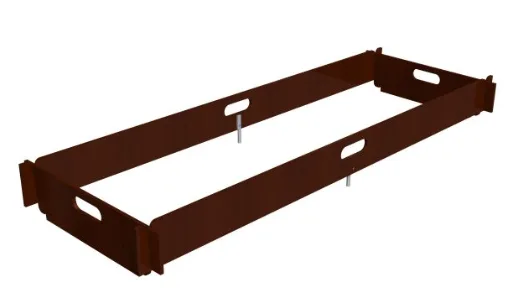
Toe boards and material stored above them
The current rule contains conditions for toe boards and addresses material piled above their top edge. A toe board is one component of a complete edge and falling-object strategy; its presence does not prove that screens, panels, barricades, or another control are unnecessary.
Select toe boards by exact system, width, length, clips, and platform relationship. Narrow and wide labels do not establish compatibility across families.
Screens, panels, nets, canopies, and catch platforms
Different controls prevent passage, contain material, deflect objects, or keep employees out of the exposure zone. The applicable strength, opening, dimension, placement, and support criteria must come from the current rule and design—not from a generic illustration.
Canopies and catch platforms can introduce their own support, load, clearance, wind, and access questions. They should not be improvised from ordinary scaffold parts.
Material handling and housekeeping
Limit material to the intended task and verified loading plan. Keep access and platforms clear, secure items as required, and control hoisted or transferred materials. Tool tethering may support a site program but is not presented here as a universal substitute for regulatory controls.
Inspection should verify toe-board and screen attachment, damage, missing sections, opening protection, stored material, debris, and changes to work below.
Apply this topic through a controlled project record
Begin the scaffold falling-object protection review with evidence rather than assumptions. Record the exact scaffold family, model and component markings; retain the current manufacturer instructions; identify the applicable sections of the current OSHA standard; and document the work activity, environment, dimensions, loading inputs, access route, surrounding operations, and responsible personnel. If the supplied PDF, an older manual, a current product document, and the present worksite appear to point in different directions, preserve the conflict and obtain clarification instead of selecting the most convenient statement.
Separate product facts from project decisions. A verified part number, platform dimension, or manual relationship can support identification, but it does not decide the foundation, assembly, permitted loading, fall-protection method, inspection outcome, training adequacy, or site authorization. Those decisions depend on the complete configuration and the people assigned responsibility by the rule, employer program, design documents, and manufacturer instructions. A change to one component or work condition may require the review to be reopened.
Use photographs and drawings carefully. Capture labels, connections, damage, clearances, openings, floor or ground conditions, and the relationship to the work face without treating a photograph as proof of structural capacity. Do not send classified, export-controlled, proprietary, or sensitive facility information through a general website form. Upright Scaffold can arrange an approved transfer process for authorized files when a product or custom-platform inquiry requires them.
A commercial request should identify what needs to be quoted and what remains unresolved. Include quantities, destination, requested timing, known product codes, and whether purchase or rental is being considered, while listing technical questions separately. Written pricing, availability, shipping, and compatibility confirmation do not replace the current safety requirements or authorize use. If critical specifications, instructions, compatibility, or responsible-person decisions are missing, stop the selection process and request the necessary documentation.
Official OSHA sources
Use these descriptive links to verify current wording and navigate to the complete official context. External OSHA pages open in a new tab.
OSHA 1926.450 Subpart L scaffold publication, 59 pages, PDF. Preserved without modification.